By Mark Leonard Melni—-Water in the Desert: The Engineering Genius of the Ancestral Puebloans
By Mark Melni
Introduction:
Before discussing, we need to start with some background.
For years, one question about the ancient people of the American Southwest has fascinated me: Where was the water? How did a civilization flourish for centuries in such a dry and unforgiving landscape? That question sent me down an unexpected path—one that eventually led to an idea I never anticipated and a series of experiments I never expected to work… but they did.
Most Americans have heard of Mesa Verde. Mention the cliff dwellings, and almost everyone has some idea of what you mean.
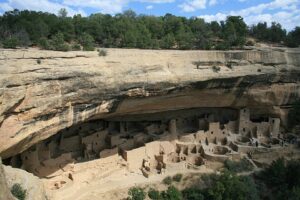
Mesa Verde National Park, Colorado, Credit Andreas F. Borchert
Chaco Canyon is different. I am an American, and I certainly didn’t grow up hearing or knowing anything about Chaco Canyon. I didn’t discover it until around 2010, when I was looking at Google Maps and came across Pueblo Bonito. I remember looking at this enormous ancient structure sitting out in the middle of the New Mexico desert and wondering: What in the world is that? That discovery eventually changed the direction of my life.
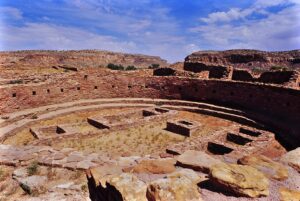
The Chaco Culture National Historical Park. Credit Pedro Mendes
Recently, I gave a presentation to my local Kiwanis Club about a question that had been puzzling me: Where did the people of the ancient Southwest get their water? Before explaining where that question had taken me, I wanted to know how familiar the audience was with Chaco Canyon, dowsing, and some of the basic ideas that had shaped my investigation. It was interesting to see what people knew—and what they didn’t.
Almost everyone knew Mesa Verde, but very few knew Chaco Canyon. Similarly, when I asked about dowsing, I didn’t get much reaction. When I called it witching, suddenly about a third of the room knew what I was talking about. Only two or three people were familiar with the old candle, bowl of water and inverted glass experiment (which I will describe later). Almost everyone, however, knew about cupping, where lower pressure is created inside a cup placed against the skin (these cups are coated with alcohol, then ignited just before they’re placed on the skin). These seemingly unrelated things lead us toward an important idea: lower pressure (partial vacuum) might allow water to be pushed (sucked) into the kiva.
For anyone unfamiliar with Chaco Canyon, I would encourage you to begin with the work of Anna Sofaer, whose research brought extraordinary attention to the astronomical knowledge embodied in Chaco’s architecture and landscape. Her discovery of the famous Sun Dagger on Fajada Butte helped reveal just how sophisticated the people of Chaco were in their observations of the sun, moon and the passage of time.
I would then encourage you to watch Anna Sofaer’s documentary The Mystery of Chaco Canyon, narrated by Robert Redford. It is approximately an hour long and, in my opinion, is the best introduction I have found to Chaco, Pueblo Bonito, the Great Houses, the astronomical alignments and the sheer scale of what was built there. Once you understand Chaco a little better, one question becomes almost impossible to ignore:
Where was the water?
I am an inventor, not an archaeologist, and perhaps that’s why I began looking at the kivas (ceremonial and communal chambers built by Pueblo peoples of the American Southwest) a little differently. When I first visited the great houses of Chaco Canyon, I was overwhelmed by what the ancestral Pueblo people had accomplished in such an unforgiving environment. But one question kept bothering me: Where was the water? Thousands of people had lived, worked and built these enormous structures in a desert. Water wasn’t optional. They had to have it.
My investigation began in an unusual way—with one of the oldest methods people have used in the search for water. I have practiced dowsing, historically known in America as water witching, for many years. Long before modern geological surveys, drilling records, and electronic instruments, people used a forked branch (or a pair of copper rods) in an attempt to locate water beneath the ground. The practice has survived for generations and is still used today, particularly in rural communities.
I understand that dowsing is controversial and is not accepted by mainstream science as a reliable method of locating groundwater. I am not asking the reader to accept dowsing as scientific proof of anything that follows. But I am asking that it be understood for what it was in my investigation: the tool that pointed me toward the water and started the experiment. Without dowsing, I would never have considered alternative sources of water.
If you have never heard of dowsing or water witching, ask your grandparents. There’s a pretty good chance they’ll know exactly what you’re talking about!
Agriculture in Britain- Life on George Casely’s Farm, Devon, England, 1942 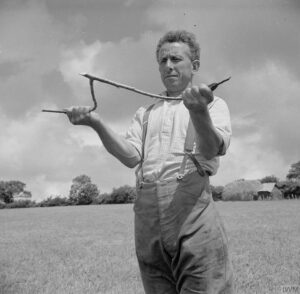
I took my dowsing rods with me to Chaco Canyon and began walking around Pueblo del Arroyo. Again and again, when I crossed the locations of kivas, the rods indicated what I interpreted as shallow underground aquifers. I repeated the process at other locations throughout Chaco Canyon, including Pueblo Bonito, Chetro Ketl, Casa Rinconada, Kin Kletso, and Una Vida; all showed indications of aquifers. Later, I took my rods to other ancestral Pueblo sites, including Salmon Ruins, Aztec Ruins, and Mesa Verde, and I continued to encounter the same intriguing pattern:
In my dowsing, the strongest indications of underground aquifers occurred at the kivas.
Again, I am not asking the reader to take my word for this. In fact, I encourage anyone interested in this theory to investigate it for themselves. Take a pair of dowsing rods (copper welding rods work) or find someone experienced in water witching and, if you’re lucky enough to live in the Four Corners area, visit these sites and see what happens. What mattered to me was the consistency of the pattern I was seeing. It caused me to stop looking at the kiva only as a ceremonial structure and ask a completely different question:
Could the kiva itself have had something to do with water?
Instead of looking only at its accepted ceremonial function, I began looking at the structure through the lens of an inventor. I saw an enclosed chamber, a fire pit, a ventilation system, a smoke opening in the roof and the sipapu, the small opening in the floor that carries profound traditional and symbolic meaning in Pueblo culture. I wondered whether these architectural elements might also permit a physical process involving heat, cooling and changes in atmospheric pressure. A structure can have more than one purpose. Recognizing a possible mechanical function would not require denying its ceremonial importance.
My theory is simple: the ancient Puebloans may have had access to more water than we realize. I believe they understood where shallow underground water could be found and developed a way to bring that water to the surface. Could the Kiva have somehow acted like a pump or syphon to bring water out of the ground? The question that started it all was simply: Where was the water?
A simple experiment helped me understand what might be possible. Put a small candle in a shallow bowl of water, light it, and lower an inverted drinking glass over it so the rim of the glass enters the water. The candle continues burning briefly and then goes out. Afterwards, water rises inside the glass. This experiment is sometimes incorrectly explained by saying that the candle simply consumes the oxygen and the water replaces it. The actual physics are more complicated. The gas inside the glass is heated; combustion changes its composition; water vapor and carbon dioxide are produced; gases move between the glass and its surroundings before the rim becomes fully isolated; and after the flame goes out, the enclosed gases cool and water vapor condenses. The resulting pressure inside the glass can become lower than atmospheric pressure. The greater atmospheric pressure acting on the water outside the glass then pushes water upward into the lower-pressure space. That distinction is important. The water isn’t being mysteriously “sucked” upward. Atmospheric pressure is pushing it upward.
My sister Cheryl, a 30-year Registered Nurse, then reminded me about the ancient practice of cupping, and that became one of my Eureka moments. In traditional fire cupping, burning a thin coating of alcohol inside a cup and then placing the cup against the skin creates a pressure differential as the gas subsequently cools and condenses. Again, I wasn’t interested in whether cupping has therapeutic value. I was interested in what the cup demonstrated physically: heat a confined volume of gas, seal it, allow the conditions inside to change, and atmospheric pressure can produce a surprisingly strong mechanical force.
Then I encountered an even better analogy: Thomas Newcomen’s atmospheric engine, developed in the early eighteenth century to pump water from mines. Newcomen admitted low-pressure steam into a cylinder and then introduced cold water, causing the steam to condense rapidly. The enormous reduction in volume associated with condensation produced a partial vacuum beneath the piston. Atmospheric pressure acting on the other side of the piston then drove it downward. The genius of the machine was not that the vacuum itself contained some mysterious pulling force. The pressure difference allowed the atmosphere to do the work.
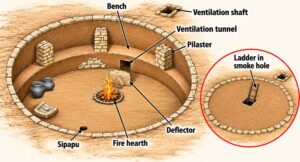
Unknown Artist
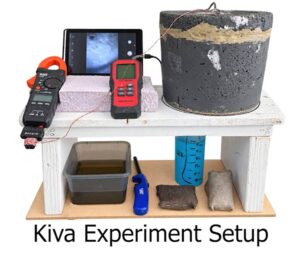
I built a small concrete model based on the basic features of a traditional kiva. It includes a smoke hole in the roof, a fire pit inside, a side opening representing the downward flue, and a small diffuser positioned between the fire pit and the flue. A straw passes through the floor to represent the sipapu, with its lower end extending into a container of water beneath the model—representing a shallow underground water source.
The principle is actually quite simple. Normal atmospheric pressure at sea level is approximately 14.7 pounds per square inch (psi). During my prototype experiments, the pressure inside the sealed chamber dropped to the −2.98 psi limit of my manometer (an E showed on the meter). The instrument could measure no farther, so the actual vacuum produced by the prototype was greater.
Using only the pressure difference that was actually observed, the chamber pressure would have been approximately:
14.7 psi − 2.98 psi = 11.72 psi
The measured pressure difference was therefore at least:
14.7 psi − 11.72 psi = 2.98 psi
A pressure difference of 2.98 psi is theoretically capable of supporting a column of water approximately:
2.98 psi × 2.31 feet of water per psi = 6.88 feet
In other words, the vacuum actually observed in the prototype was theoretically sufficient to raise water nearly seven feet—and because the manometer had reached its measuring limit, the actual pressure difference may have been greater. Put more simply: create sufficiently low pressure inside a sealed chamber, connect that chamber to water below, and atmospheric pressure can push the water upward.
Jonathan Till, an archaeologist at the Edge of the Cedars State Park Museum in Blanding, Utah, gave me the advice that finally moved this idea from speculation into experiment: build one and find out. So, I did just that (I need to mention that my wife, Mary, said from the beginning that I should build a prototype… sound familiar, guys?).
I constructed a small cylindrical concrete prototype based on all the functional features of a standard kiva. My current prototype has an internal capacity of approximately 106 fluid ounces. It includes a fire pit, a connection to a water source (through a straw), a ventilation opening, and an upper smoke opening, both of which can be sealed. I began experimenting with different sequences of heating and sealing, and the prototype taught me something I hadn’t anticipated when I first developed the theory:
The critical discovery was the seal at the top.
I use a flat cover over the upper smoke opening together with a piece of animal hide. Initially, wetting the hide was simply a practical matter: a saturated hide is soft and conforms extremely well to an irregular surface opening, producing a remarkably effective seal. But during testing, I realized that the water in the hide might be doing something much more important. The hide was not merely damp—it was saturated with water. When I place that cool, water-saturated hide over the opening of the hot chamber, I simultaneously seal the chamber and introduce a relatively cool, wet surface into contact with the hot, moisture-laden environment immediately beneath it.
That brought me straight back to Thomas Newcomen.
In his atmospheric engine, the introduction of cold water accelerated the condensation of steam and produced the pressure drop that made the engine operate. My kiva prototype is obviously not a Newcomen engine, and combustion gases are not pure steam, but the analogy suggested a testable mechanism: could the saturated hide accelerate cooling and condensation sufficiently to contribute significantly to the pressure drop inside the sealed chamber? Now that is one of the most important questions raised by the experiment.
The operating sequence I eventually developed is surprisingly simple. I establish a fire inside the prototype and allow the chamber to become hot. I then seal the ventilation opening and the upper smoke opening simultaneously, using the saturated hide at the top. After the flame is extinguished and the chamber conditions change, the internal pressure falls. Water then moves from the reservoir below and enters the kiva at great speed. During repeated trials, the prototype has brought approximately 18 to 22 fluid ounces of water into a chamber whose total volume is approximately 106 fluid ounces. Using the average 20-ounce figure*
20 ÷ 106 × 100 = 18.9%
That means the water entering during a cycle represents approximately 18.9% of the prototype’s nominal chamber volume. At 22 ounces, the figure is approximately 20.8%. I have repeated the experiment successfully multiple times, including repeated consecutive cycles, and the phenomenon is readily observable.
*(The attached video shows the prototype drawing approximately 12 ounces of water. In earlier testing, before the prototype was mounted on the demonstration stand, I repeatedly measured approximately 20–22 ounces per cycle. Mounting the prototype required additional connections and seals, which may have introduced small air leaks and reduced the vacuum produced inside the model. Even with the lower volume, however, the basic process remained clearly observable.)
That repeatability changed my thinking. I no longer need to ask whether a heated, sealed kiva-like chamber can create enough of a pressure differential to move a substantial amount of water. My prototype demonstrates that it can under the conditions I have created. What it absolutely does not prove is that ancestral Pueblo people used archaeological kivas for this purpose. The archaeological proposition requires archaeological evidence. Were actual kivas sufficiently airtight? Were openings capable of being sealed? Could the sipapu have been dug deep enough to contact the aquifers beneath the structure? These questions need answers. Archaeologists, geologists, hydrologists and Pueblo experts, not merely an inventor, need to weigh in.
There is another reason I think this deserves investigation. If the underlying principle scales, this isn’t necessarily only a question about the past. A modern experimental structure could be built above a verified aquifer or water source and tested at a much larger scale. I would probably still arrive carrying my dowsing rods—that is part of who I am and how this whole adventure began—but any serious modern experiment should locate and characterize the aquifer independently using established geological and hydrological methods. Then we could build the structure, instrument it, light the fire and let the measurements decide the truth.
I am not asking anyone to believe that I have solved the mystery of the kiva or the mystery of why they left the sites. I am asking archaeologists and scientists to consider an experiment that produces a real and repeatable physical result. The beauty of an experimental claim is that nobody has to take my word for it. Build one. Measure it. Try to make it fail. Change the variables. Put a dry hide on the smoke opening and compare it with a saturated one. Measure exactly what happens to temperature, pressure and water movement.
If the hypothesis is wrong, good experimentation will expose it.
If some part of it is right, we may have found a physical capability of this remarkable society that has been overlooked.
Years ago I walked into Chaco Canyon carrying a pair of dowsing rods and asking myself a very simple question: Where is the water? Eventually that question led me to a concrete cylinder in my workshop, a fire, a saturated piece of animal hide and about twenty ounces of water that kept appearing inside the chamber time after time.
I don’t know about you – but I’m excited!
Mark Melni
Mechanics Behind the Theory
A quick breakdown of the core forces behind the Kiva Theory.
Combustion creates thermal energy inside the chamber.
Water vapor expands and alters internal pressure.
As vapor cools, pressure may rapidly decrease.
The pressure drop may help pull shallow groundwater upward.